












































Published by Safetywear Direct — A Division of Workwear Direct
The Problem Is Bigger Than You Think
More than 1.1 million Australians are exposed to hazardous noise in their workplace. Between 2015 and 2022, Australian workers lodged close to 30,000 workers' compensation claims for hearing loss, the vast majority from long-term exposure that built up quietly, shift by shift, over years.
Occupational noise-induced hearing loss carries an estimated economic burden of AUD $29.7 billion, with productivity losses accounting for 72% of that cost.
There is no fix once the damage is done. No surgery. No medication. Hearing aids manage the problem, they don't reverse it. For Australian businesses operating in construction, rail, mining, engineering and manufacturing, this is not a background issue. It is a legal obligation, a liability exposure, and a direct duty of care to your workforce.
The Legal Framework: What Australian Law Requires
The Exposure Standard
Under the model Work Health and Safety Regulations, the daily noise exposure level must not exceed 85 dB(A) measured over an eight-hour shift, and the peak level must not exceed 140 dB(C).
Decibels are logarithmic: a 3 dB increase doubles the sound energy, meaning every 3 dB of additional noise level reaches the same daily dose in half the time. A site running at 88 dB(A) is not slightly louder than the limit, it halves the safe exposure window to four hours.
The Hierarchy of Controls
Hearing protection is the last resort, not the first line of defence. Under Australian WHS law, Persons Conducting a Business or Undertaking (PCBUs) must work through the hierarchy of controls:
- Eliminate the noise source where possible
- Substitute quieter equipment
- Engineer the noise out — barriers, enclosures, dampening
- Administer — rotate workers, limit exposure time
- PPE — hearing protection when all above measures are insufficient or impractical
Only when engineering and administrative controls cannot bring exposure below the standard does mandated hearing PPE come into play. At that point, selection, fit, maintenance and program management all become legal requirements.
Understanding the Australian Standard: AS/NZS 1270
Every piece of hearing protection used on an Australian worksite must comply with AS/NZS 1270:2002 — Acoustics: Hearing Protectors. This is the standard that governs how hearing protectors are tested, classified and labelled for use in Australia and New Zealand.
The SLC80 Rating System
The rating system specified in AS/NZS 1270 uses a metric called SLC80 — Sound Level Conversion at the 80th percentile. This indicates the noise reduction in decibels that can be expected for 80% of wearers when the product is correctly fitted, accounting for real-world variability in fit between users.
Compliance with WHS regulations requires hearing protection that meets AS/NZS 1270. A product rated only under the American NRR system — with no AS/NZS 1270 marking — has not been tested and classified to the Australian standard and cannot confirm compliance for use as PPE on an Australian worksite.
The Five Protection Classes
The SLC80 value assigns hearing protection to one of five classes:
- Class 1: SLC80 10–13 dB — low-level environments
- Class 2: SLC80 14–17 dB — moderate noise
- Class 3: SLC80 18–21 dB — factories, industrial environments
- Class 4: SLC80 22–25 dB — loud worksites, power tools
- Class 5: SLC80 26 dB and above — heavy industry, mining
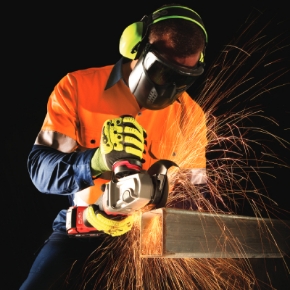
For example, a worker operating an angle grinder exposed to 98 dB(A) over an eight-hour shift requires a Class 3 protector with an SLC80 between 18 and 21.
Matching the correct class to the correct environment is not optional. Under-protection is an obvious failure. But over-protection — selecting a Class 5 protector for a moderate noise environment — creates its own problem: workers become isolated from site communication and warning signals, creating a different safety risk.
Safe Work Australia recommends selecting protection so that exposure at the ear remains between 70 and 80 dB(A), minimising hearing risk while reducing communication difficulties and the risks associated with over-attenuation.
The Hearing Protector Program: AS/NZS 1269.3
Buying the right class of PPE is step one. Running a compliant hearing protector program is the ongoing obligation.
The AS/NZS 1269 series provides the framework for occupational noise management, while Work Health and Safety Regulations establish the legal requirements for noise exposure assessment and control.
AS/NZS 1269.3 establishes the requirements for an effective hearing protector program, covering the proper issue, fitting, education and monitoring of hearing protection devices.
A compliant program includes:
- Formal noise assessment by a qualified assessor under AS/NZS 1269.1
- Selection of correctly rated PPE matched to the environment
- Documented fit and issue procedures for all workers
- Training on correct fitting, care and maintenance
- Regular inspection and replacement of worn or damaged PPE
- Records kept and available for WHS inspection
Audiometric Testing: The New Legal Obligation Across Australia
This is where many Australian businesses are currently exposed and regulators are actively enforcing it.
Under WHS Regulation 58, audiometric testing is a legal obligation for every PCBU with workers frequently required to use hearing protection. It is not aspirational best practice. It is the law.
From 1 January 2024, NSW employers are required to provide and pay for audiometric testing for any workers frequently required to use personal protective hearing equipment. From 29 July 2025, Queensland followed, requiring testing within three months of a worker commencing a role requiring HPE, and at minimum every two years thereafter. Victoria, South Australia, Tasmania and the ACT operate under equivalent obligations.
Audiometric testing is non-invasive, takes minutes, and catches early-stage hearing deterioration before it becomes permanent impairment. Audiometric records must be kept for at least 30 years from the date of the last entry, reflecting the long-latency nature of noise-induced hearing loss and its relevance to future workers' compensation claims. The failure to provide testing creates significant liability exposure if a worker later claims permanent hearing damage.
What This Means for Your Business Right Now
If your workforce operates in construction, rail, mining, manufacturing, engineering or any environment where noise regularly exceeds 85 dB(A) and your teams are wearing hearing PPE, you have active legal obligations. Not pending ones. Current ones.
Your compliance checklist:
✅ Formal noise risk assessment completed and documented
✅ Hearing PPE selected to the correct AS/NZS 1270 Class for each environment
✅ Hearing PPE carries AS/NZS 1270 certification — not US NRR rating only
✅ Hearing protector program in place per AS/NZS 1269.3
✅ Workers trained on correct fit, use, maintenance and replacement
✅ Audiometric testing program established and baseline tests underway
✅ Audiometric records held securely for 30-year retention period
✅ WHS inspection-ready documentation across all the above
The Bottom Line
Construction and manufacturing carry the highest rates of workers' compensation claims for occupational hearing loss in Australia and more than half a million Australian workers are estimated to experience constant tinnitus as a direct result of workplace noise exposure.
The cost of running a compliant hearing protection program is a fraction of a single workers' compensation claim, a WHS enforcement action, or the cost financial and human of a workforce with preventable permanent hearing loss.
The legislation is clear. The standards are documented. The enforcement is active. What sits between your business and compliance is a decision to treat this seriously.
Your trusted partner
Need help specifying the right hearing protection class for your sites and teams?
Safetywear Direct (a division of Workwear Direct) supplies AS/NZS 1270-certified hearing PPE across all five classes for Australian industry, government and construction workforces.
Whether you need a single site kitted out or a national supply program across multiple operations, we'll help you spec the right product, at the right protection level, for the right environment.
Contact Safetywear Direct today for expert advice and a free quote for your team.
Safetywear Direct is a division of Workwear Direct — supplying compliant workwear, safety wear and PPE to Australian industry.

That article is grounded entirely in current, verified Australian legislation and standards — WHS Regulations (December 2025 consolidation), AS/NZS 1270:2002, AS/NZS 1269.3, the Safe Work Australia Code of Practice (November 2024 edition), and state-specific obligations current to 2025–2026.
